 Add to Chrome
 Add to Firefox
 Add to Edge
Learning Latent Dynamical Causal Processes for Single-Cell Perturbation Prediction
May 25, 2026
Single-cell perturbation prediction aims to infer how cells respond to unseen interventions and to achieve out-of-distribution (OOD) generalization, providing a computational route to understanding how perturbations reshape cellular programs over time. Existing machine learning methods have made important progress, but typically capture only one side of the response. Latent causal approaches seek mechanisms that support generalization and interpretation, yet often treat perturbation effects as static outcomes. Temporal models describe how gene expression changes across time, but usually do not explicitly recover the latent causal generative mechanisms driving these changes. In practice, perturbation effects are both latent and dynamical: interventions act through unobserved cellular programs, whose states evolve over time and give rise to observed expression profiles. Motivated by this view, we propose a latent dynamical causal generative model for single-cell perturbation data that jointly captures latent cellular programs, perturbation-conditioned mechanisms, and temporal evolution. We further provide an identifiability analysis showing that, under suitable conditions, the latent causal variables are recoverable up to standard equivalence classes. Guided by this analysis, we develop CITE-VAE, a learning framework for recovering latent cellular programs and their perturbation-driven dynamics from single-cell sequencing data. Experiments on Causal-3DIdent validate the theoretical results and the effectiveness of the proposed method in controlled settings. Additional experiments on real-world CRISPR-based single-cell perturbation data show improved generalization to unseen perturbations compared with state-of-the-art baselines, highlighting the practical robustness of our approach.

What Makes a Representation Good for Single-Cell Perturbation Prediction?
May 19, 2026Single-cell perturbation modeling is fundamental for understanding and predicting cellular responses to genetic perturbations. However, existing approaches, from causal representation learning to foundation models, often struggle with an overlooked challenge: gene expression is dominated by perturbation-invariant information, while perturbation-specific signals are intrinsically sparse. As a result, learned representations either entangle invariant and perturbation-specific information, leading to spurious and non-generalizable predictors, or suppress perturbation-specific signals altogether, rendering them ineffective for prediction. To address this, we propose PerturbedVAE, a general framework designed to resolve this signal imbalance. The framework explicitly separates perturbation-specific information from dominant invariant structure and recovers causal representations to effectively utilize such information for prediction. We further provide an identifiability analysis that characterizes the conditions under which sparse perturbation effects can be reliably recovered, thereby clarifying how the framework can be concretely specified under such conditions. Empirically, PerturbedVAE achieves state-of-the-art performance on a widely used benchmark across multiple evaluation settings, yielding significant gains on out-of-distribution combinatorial predictions and uncovering interpretable perturbation-response programs.
Chem4DLLM: 4D Multimodal LLMs for Chemical Dynamics Understanding
Mar 12, 2026Existing chemical understanding tasks primarily rely on static molecular representations, limiting their ability to model inherently dynamic phenomena such as bond breaking or conformational changes, which are essential for a chemist to understand chemical reactions. To address this gap, we introduce Chemical Dynamics Understanding (ChemDU), a new task that translates 4D molecular trajectories into interpretable natural-language explanations. ChemDU focuses on fundamental dynamic scenarios, including gas-phase and catalytic reactions, and requires models to reason about key events along molecular trajectories, such as bond formation and dissociation, and to generate coherent, mechanistically grounded narratives. To benchmark this capability, we construct Chem4DBench, the first dataset pairing 4D molecular trajectories with expert-authored explanations across these settings. We further propose Chem4DLLM, a unified model that integrates an equivariant graph encoder with a pretrained large language model to explicitly capture molecular geometry and rotational dynamics. We hope that ChemDU, together with Chem4DBench and Chem4DLLM, will stimulate further research in dynamic chemical understanding and multimodal scientific reasoning.
Concept Component Analysis: A Principled Approach for Concept Extraction in LLMs
Jan 29, 2026Developing human understandable interpretation of large language models (LLMs) becomes increasingly critical for their deployment in essential domains. Mechanistic interpretability seeks to mitigate the issues through extracts human-interpretable process and concepts from LLMs' activations. Sparse autoencoders (SAEs) have emerged as a popular approach for extracting interpretable and monosemantic concepts by decomposing the LLM internal representations into a dictionary. Despite their empirical progress, SAEs suffer from a fundamental theoretical ambiguity: the well-defined correspondence between LLM representations and human-interpretable concepts remains unclear. This lack of theoretical grounding gives rise to several methodological challenges, including difficulties in principled method design and evaluation criteria. In this work, we show that, under mild assumptions, LLM representations can be approximated as a {linear mixture} of the log-posteriors over concepts given the input context, through the lens of a latent variable model where concepts are treated as latent variables. This motivates a principled framework for concept extraction, namely Concept Component Analysis (ConCA), which aims to recover the log-posterior of each concept from LLM representations through a {unsupervised} linear unmixing process. We explore a specific variant, termed sparse ConCA, which leverages a sparsity prior to address the inherent ill-posedness of the unmixing problem. We implement 12 sparse ConCA variants and demonstrate their ability to extract meaningful concepts across multiple LLMs, offering theory-backed advantages over SAEs.
The Geometric Mechanics of Contrastive Representation Learning: Alignment Potentials, Entropic Dispersion, and Cross-Modal Divergence
Jan 27, 2026While InfoNCE powers modern contrastive learning, its geometric mechanisms remain under-characterized beyond the canonical alignment--uniformity decomposition. We present a measure-theoretic framework that models learning as the evolution of representation measures on a fixed embedding manifold. By establishing value and gradient consistency in the large-batch limit, we bridge the stochastic objective to explicit deterministic energy landscapes, uncovering a fundamental geometric bifurcation between the unimodal and multimodal regimes. In the unimodal setting, the intrinsic landscape is strictly convex with a unique Gibbs equilibrium; here, entropy acts merely as a tie-breaker, clarifying "uniformity" as a constrained expansion within the alignment basin. In contrast, the symmetric multimodal objective contains a persistent negative symmetric divergence term that remains even after kernel sharpening. We show that this term induces barrier-driven co-adaptation, enforcing a population-level modality gap as a structural geometric necessity rather than an initialization artifact. Our results shift the analytical lens from pointwise discrimination to population geometry, offering a principled basis for diagnosing and controlling distributional misalignment.
Learning to Reason and Navigate: Parameter Efficient Action Planning with Large Language Models
May 12, 2025The remote embodied referring expression (REVERIE) task requires an agent to navigate through complex indoor environments and localize a remote object specified by high-level instructions, such as "bring me a spoon", without pre-exploration. Hence, an efficient navigation plan is essential for the final success. This paper proposes a novel parameter-efficient action planner using large language models (PEAP-LLM) to generate a single-step instruction at each location. The proposed model consists of two modules, LLM goal planner (LGP) and LoRA action planner (LAP). Initially, LGP extracts the goal-oriented plan from REVERIE instructions, including the target object and room. Then, LAP generates a single-step instruction with the goal-oriented plan, high-level instruction, and current visual observation as input. PEAP-LLM enables the embodied agent to interact with LAP as the path planner on the fly. A simple direct application of LLMs hardly achieves good performance. Also, existing hard-prompt-based methods are error-prone in complicated scenarios and need human intervention. To address these issues and prevent the LLM from generating hallucinations and biased information, we propose a novel two-stage method for fine-tuning the LLM, consisting of supervised fine-tuning (STF) and direct preference optimization (DPO). SFT improves the quality of generated instructions, while DPO utilizes environmental feedback. Experimental results show the superiority of our proposed model on REVERIE compared to the previous state-of-the-art.
Negate or Embrace: On How Misalignment Shapes Multimodal Representation Learning
Apr 16, 2025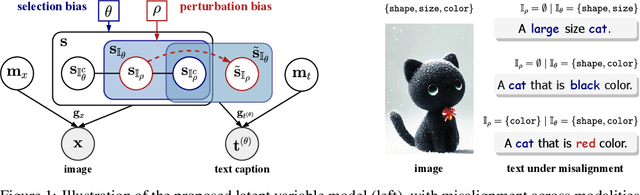
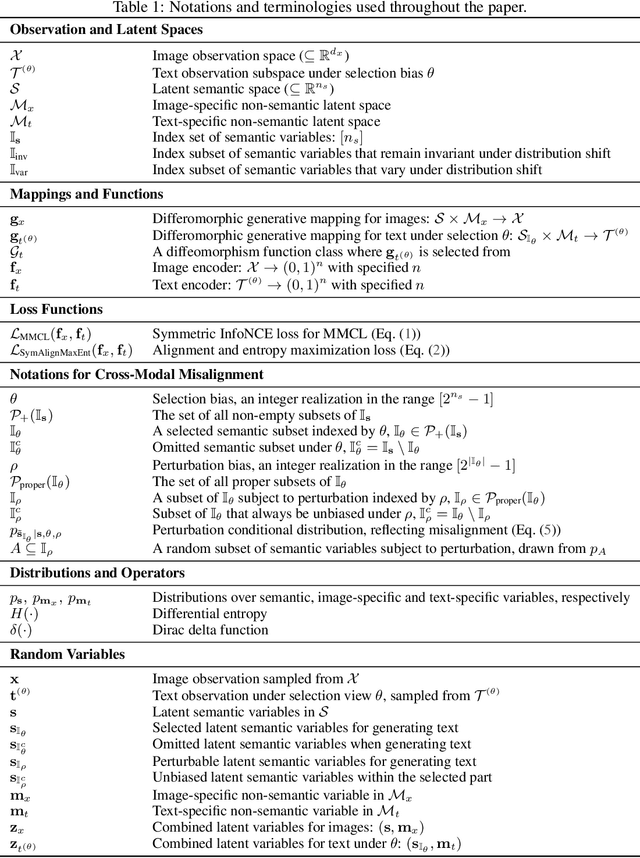
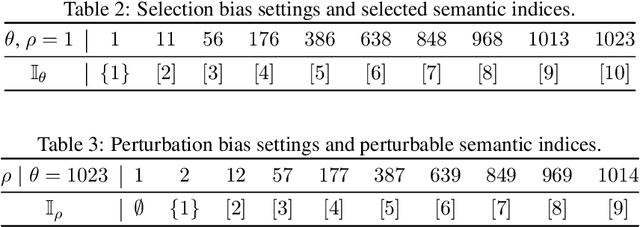
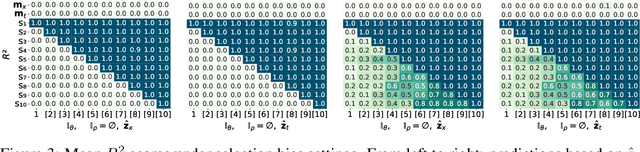
Multimodal representation learning, exemplified by multimodal contrastive learning (MMCL) using image-text pairs, aims to learn powerful representations by aligning cues across modalities. This approach relies on the core assumption that the exemplar image-text pairs constitute two representations of an identical concept. However, recent research has revealed that real-world datasets often exhibit misalignment. There are two distinct viewpoints on how to address this issue: one suggests mitigating the misalignment, and the other leveraging it. We seek here to reconcile these seemingly opposing perspectives, and to provide a practical guide for practitioners. Using latent variable models we thus formalize misalignment by introducing two specific mechanisms: selection bias, where some semantic variables are missing, and perturbation bias, where semantic variables are distorted -- both affecting latent variables shared across modalities. Our theoretical analysis demonstrates that, under mild assumptions, the representations learned by MMCL capture exactly the information related to the subset of the semantic variables invariant to selection and perturbation biases. This provides a unified perspective for understanding misalignment. Based on this, we further offer actionable insights into how misalignment should inform the design of real-world ML systems. We validate our theoretical findings through extensive empirical studies on both synthetic data and real image-text datasets, shedding light on the nuanced impact of misalignment on multimodal representation learning.
The Devil is in the Distributions: Explicit Modeling of Scene Content is Key in Zero-Shot Video Captioning
Mar 31, 2025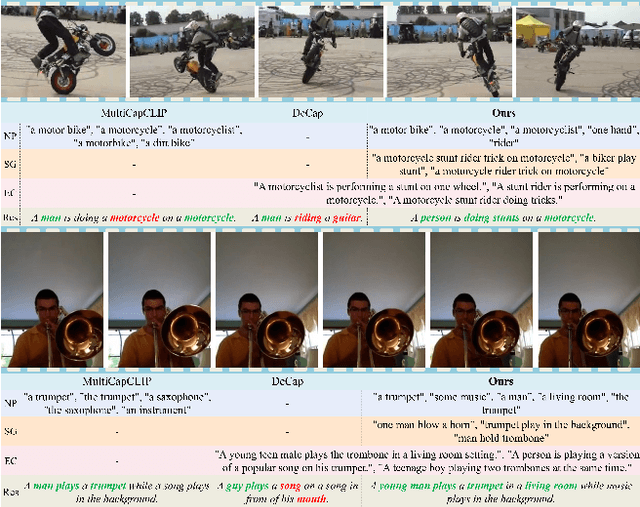
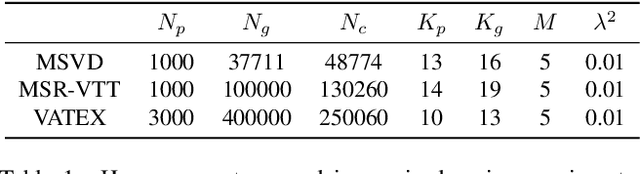
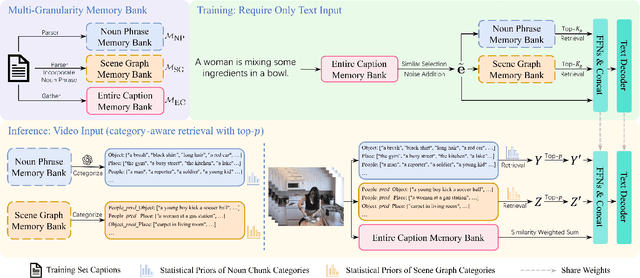
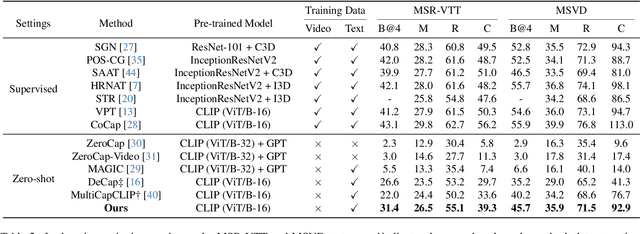
Zero-shot video captioning requires that a model generate high-quality captions without human-annotated video-text pairs for training. State-of-the-art approaches to the problem leverage CLIP to extract visual-relevant textual prompts to guide language models in generating captions. These methods tend to focus on one key aspect of the scene and build a caption that ignores the rest of the visual input. To address this issue, and generate more accurate and complete captions, we propose a novel progressive multi-granularity textual prompting strategy for zero-shot video captioning. Our approach constructs three distinct memory banks, encompassing noun phrases, scene graphs of noun phrases, and entire sentences. Moreover, we introduce a category-aware retrieval mechanism that models the distribution of natural language surrounding the specific topics in question. Extensive experiments demonstrate the effectiveness of our method with 5.7%, 16.2%, and 3.4% improvements in terms of the main metric CIDEr on MSR-VTT, MSVD, and VATEX benchmarks compared to existing state-of-the-art.
Analytic DAG Constraints for Differentiable DAG Learning
Mar 24, 2025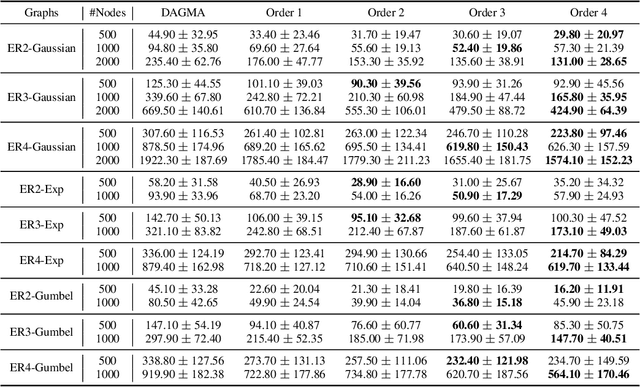
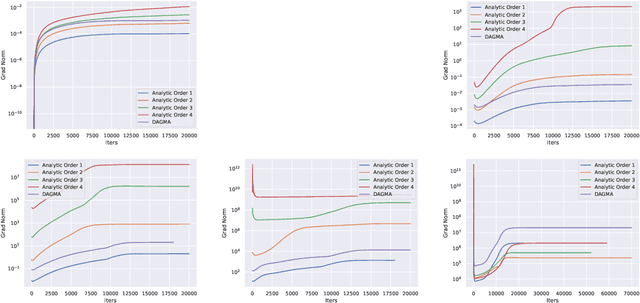
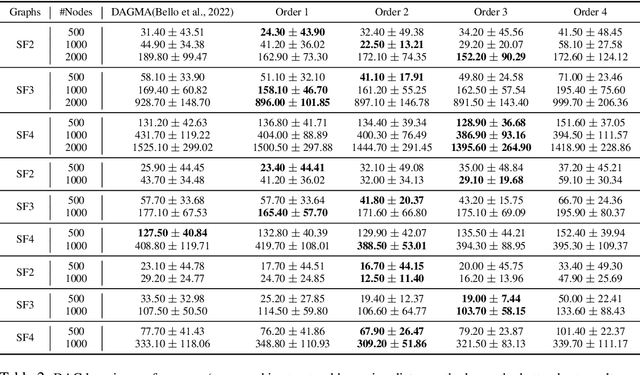

Recovering the underlying Directed Acyclic Graph (DAG) structures from observational data presents a formidable challenge, partly due to the combinatorial nature of the DAG-constrained optimization problem. Recently, researchers have identified gradient vanishing as one of the primary obstacles in differentiable DAG learning and have proposed several DAG constraints to mitigate this issue. By developing the necessary theory to establish a connection between analytic functions and DAG constraints, we demonstrate that analytic functions from the set $\{f(x) = c_0 + \sum_{i=1}^{\infty}c_ix^i | \forall i > 0, c_i > 0; r = \lim_{i\rightarrow \infty}c_{i}/c_{i+1} > 0\}$ can be employed to formulate effective DAG constraints. Furthermore, we establish that this set of functions is closed under several functional operators, including differentiation, summation, and multiplication. Consequently, these operators can be leveraged to create novel DAG constraints based on existing ones. Using these properties, we design a series of DAG constraints and develop an efficient algorithm to evaluate them. Experiments in various settings demonstrate that our DAG constraints outperform previous state-of-the-art comparators. Our implementation is available at https://github.com/zzhang1987/AnalyticDAGLearning.
* Accepted to ICLR 2025
I Predict Therefore I Am: Is Next Token Prediction Enough to Learn Human-Interpretable Concepts from Data?
Mar 12, 2025The remarkable achievements of large language models (LLMs) have led many to conclude that they exhibit a form of intelligence. This is as opposed to explanations of their capabilities based on their ability to perform relatively simple manipulations of vast volumes of data. To illuminate the distinction between these explanations, we introduce a novel generative model that generates tokens on the basis of human interpretable concepts represented as latent discrete variables. Under mild conditions, even when the mapping from the latent space to the observed space is non-invertible, we establish an identifiability result: the representations learned by LLMs through next-token prediction can be approximately modeled as the logarithm of the posterior probabilities of these latent discrete concepts, up to an invertible linear transformation. This theoretical finding not only provides evidence that LLMs capture underlying generative factors, but also strongly reinforces the linear representation hypothesis, which posits that LLMs learn linear representations of human-interpretable concepts. Empirically, we validate our theoretical results through evaluations on both simulation data and the Pythia, Llama, and DeepSeek model families.